
Does Indeed have an API? The short answer is no, not a public one.
Indeed retired its Publisher API and closed its Job Search API to new developers. There is no form you can fill out today that hands you a working key.
Here is the fuller answer. The official developer program is gone, so the pages walking you through an Indeed API key lead to dead ends. To read Indeed postings as data now, you use a third-party Indeed API that returns the same listings as normalized JSON. This explains what happened, why the old docs still show up, and the fastest way to get Indeed data today. The free tier is 100 credits with no card.
Does Indeed have a public API in 2026?
No. Indeed does not offer a public API in 2026. The Publisher API was retired, the Job Search API is closed to new developers, and there is no open endpoint a general developer can register for. What remains is employer-side access for posting jobs through applicant-tracking partners. If you want to read postings as data, the official door is shut.
This is the answer most people are actually looking for.
You searched, found old tutorials, and could not tell whether they were current. They are not. The program they describe stopped accepting developers.
The good news is that the data is still reachable. Just not through Indeed directly.
Two versions of this question exist, and mixing them up causes half the confusion. One asks whether Indeed operates any API at all, and the other asks whether you can get a key to read postings. The first is technically yes, for gated employer use. The second, the one developers mean, is no.
Keep the developer version in mind as you read. That is the one this article answers.
Does Indeed have an API for employers?
Employers have a different path than developers. Posting jobs to Indeed runs through employer accounts, applicant-tracking integrations, and sponsored-job programs, which are available but gated behind an approved relationship. Reading postings as data is the part with no public API. So the honest answer depends on which side of the marketplace you are on.
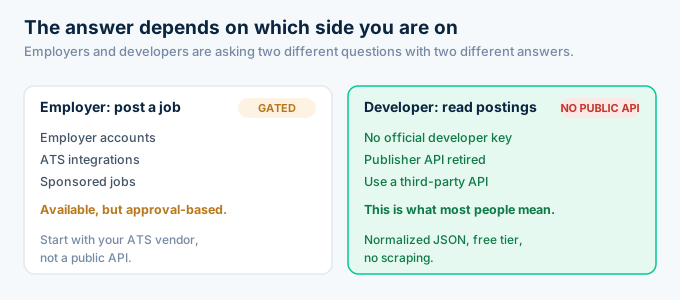
If you are hiring, you are not blocked. Your applicant-tracking vendor almost certainly already pushes jobs to Indeed, and an employer account lets you post directly.
If you are building software that reads postings, that is the closed door. There is no developer program for pulling listings out.
Most people asking whether Indeed has an API are on the developer side, which is why the answer is usually no.
Sort out which side you are on first. It changes the entire answer.
The rest of this article is for the developer side, the people who need postings as data. If you are an employer, your ATS vendor is the right first stop, not a public API.
What happened to the Indeed Publisher API?
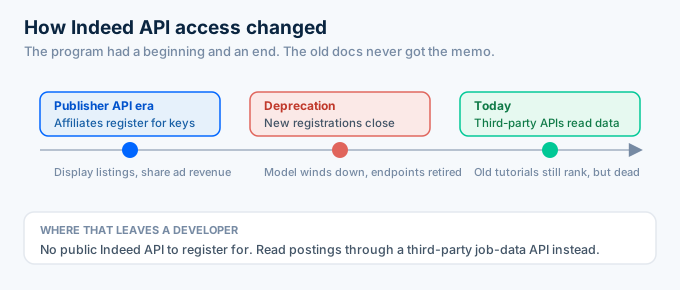
The Publisher API was wound down along with the affiliate model it served. It once let partner sites display Indeed listings and share in the ad revenue those listings generated. As Indeed shifted how it handles traffic and monetization, that program was deprecated and new registrations closed. The endpoints that remain are gated behind employer and partner relationships.
Knowing the why saves you time.
There is no hidden application form, no waitlist, and no support address that will issue a general developer a key. The decision was structural, not a temporary pause.
Sponsored job spend is a separate product. That is Indeed charging employers to promote listings, not a data feed you can build on.
What did the Indeed Publisher API used to do?
The Publisher API let approved affiliate sites pull Indeed job listings and display them, in exchange for sending traffic and sharing ad revenue. It returned search results and job details much like a modern job-data API, but access was tied to that affiliate relationship. When the business model changed, the API went with it.
It was built for a specific deal. You showed Indeed’s listings on your site, users clicked through, and everyone shared in the ad revenue.
The data it returned was recognizable: search results, job details, company information. Not far from what a job-data API returns today.
The difference was the gate. You needed to be an approved publisher, not just a developer with an account.
When Indeed changed how it wanted traffic to flow, the reason for the open program disappeared, and so did the program.
Why do old Indeed API tutorials still rank?
Old tutorials rank because the pages were published while the program was live and never removed. Search engines still surface them, so you follow a confident, step-by-step guide straight into a signup form that no longer works. The content looks current because nothing on the page says otherwise.
This is the single biggest source of confusion around the question.
A 2019 walkthrough of requesting a publisher key reads exactly like a 2026 one would. The only way to tell is that the endpoint it points at is dead.
Forums make it worse. An old thread confidently answers “yes, use the Publisher API”, and that answer sits there for years after the program closed, still collecting clicks.
So people arrive at the question already half-convinced the API exists, then bounce between dead links trying to find the signup. The article you are reading is meant to end that loop.
Treat any page offering an official Indeed developer key as out of date. If it tells you to register with Indeed directly for postings data, it is describing a program that closed.
How can you tell if an Indeed API tutorial is outdated?
Check where it sends you. If a tutorial tells you to register for an official Indeed publisher or developer key, it is outdated, because that registration is closed. Current guidance points you at a third-party job-data API instead. The date on the post is unreliable, so judge it by the destination, not the timestamp.
Look at the signup step. An outdated guide links to an Indeed developer portal that either 404s or takes your details and never returns a key.
Ignore the publish date. Many old posts get lightly refreshed to look current while still pointing at the dead program.
Watch for affiliate language. Talk of becoming an Indeed publisher or sharing ad revenue describes the retired model.
If the guide gets you to real data through a normal API key, it is current. If it routes you back to Indeed for a developer key, it is not.
What can you use instead of the Indeed API?
You have three options, and only one is low-maintenance. A third-party job-data API returns normalized Indeed postings over REST with nothing to scrape. A do-it-yourself scraper reads the site directly but breaks often and carries legal risk. A marketplace API aggregates job data with variable quality. For most developers, the managed API is the practical choice.
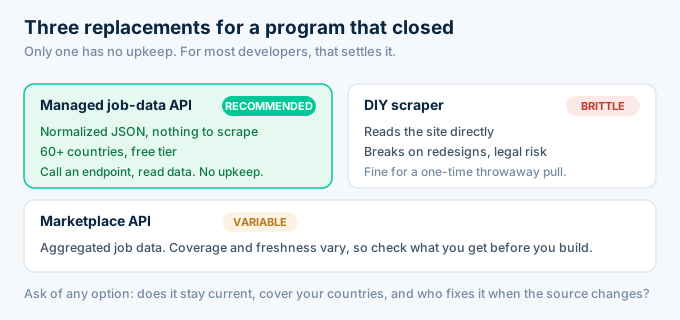
The managed API wins on effort. You call an endpoint and read JSON, with no proxies, no parsing, and no breakage when Indeed changes its site.
Scraping wins only for a one-time research pull you will throw away. For anything ongoing, the maintenance outweighs the saved subscription.
The reason is that Indeed changes its site on its own schedule. A scraper breaks whenever that happens, and you are the one who fixes it, usually at a bad time.
A marketplace listing can work, but coverage and freshness vary by provider, so check what you are actually getting before you build on it.
Ask three questions of any option: does it stay current, does it cover your countries, and who maintains it when the source changes. The managed API answers all three the same way, which is why it wins for ongoing work.
Is it legal to read Indeed data through a third-party API?
Reading public Indeed postings through a compliant third-party API is the lower-risk path. Reputable providers return public posting data under their own terms and are not affiliated with Indeed. Scraping the site yourself is where the real exposure sits, because Indeed’s terms discourage it and its systems actively block it.
The distinction is who does the sourcing. A managed provider takes that side on under its own terms, so you consume structured data rather than hammering the site.
RolesAPI is independent and not affiliated with, endorsed by, or sponsored by Indeed. Review any provider’s terms and Indeed’s trademark guidance before you build.
This is not legal advice, and your use case matters. But for most teams, a compliant API is clearly safer than running a scraper.
The practical read is simple. Reading through an API is the boring, defensible choice.
How does a third-party Indeed API compare to the old Publisher API?
It does the reading job the Publisher API used to, without the affiliate baggage. You still get Indeed postings as structured data, but through a plain bearer-key REST call instead of a partner program. A modern API adds normalization across 60+ country editions, an OpenAPI contract, and agent access, which the old Publisher API never had.
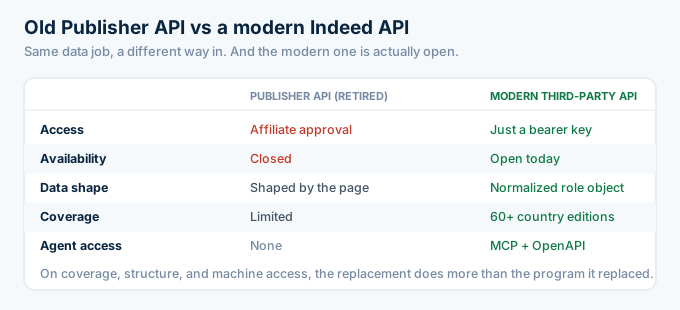
The access model is the big change.
The Publisher API assumed you were an approved affiliate. A third-party API just needs an account and a key, which is why you can start in minutes rather than waiting on an approval.
That lowered bar is the whole point. The old model served a handful of large partners, while a modern API serves any developer who signs up, from a solo builder to a team.
Normalization is the quiet upgrade. The old program handed you data shaped by the page. A modern API returns the same clean role object for every posting and every country.
Agent access is the other addition. A modern API can ship an MCP server and an OpenAPI contract, so an assistant can pull Indeed data as a tool. The Publisher API predates all of that.
So the replacement is not a step down. On coverage, structure, and machine access, a third-party API does more than the program it replaced.
How do you get Indeed job data today?
You get it in three steps: create a free account, generate a key, and call the search endpoint with a keyword and location. The response is normalized JSON, so there is no page to scrape and no parser to write. RolesAPI gives you 100 credits with no card, which is enough to pull real postings and test the whole flow.
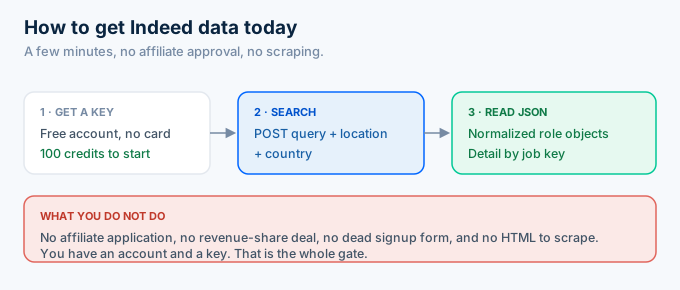
Here is the search call.
curl -X POST https://api.rolesapi.com/v1/search \ -H "Authorization: Bearer rk_live_your_key" \ -H "Content-Type: application/json" \ -d '{"query": "data engineer", "location": "Austin, TX", "country": "us"}'That returns role summaries, each with a job key. Pass a key to the detail endpoint and you get the full posting, including salary, description, and benefits.
Notice what is missing from those steps. There is no affiliate application, no revenue-share agreement, and no waiting on approval. You have an account and a key, and that is the whole gate.
The country field is where coverage comes from. Change it and the same search runs against any of 60-plus Indeed editions, which is reach the old Publisher API never offered a single developer.
No scraping, no signup form that 404s, and no waiting for a program that is not coming back.
The whole flow fits in the free tier. One hundred credits is enough to run a search, read a few full postings, and decide whether the data fits your product before you spend anything.
That is the practical end of the “does Indeed have an API” question. The official answer is no, and the working answer is a call you can make right now.
Frequently asked questions
Does Indeed have an API in 2026?
No public one. Indeed retired its Publisher API and closed its Job Search API to new developers, so there is no signup that produces a working key. Employer and applicant-tracking access remains for posting jobs. To read Indeed postings as data, developers use a third-party Indeed API such as RolesAPI, which starts free with 100 credits.
What happened to the Indeed Publisher API?
Indeed wound down the Publisher API program that once let affiliate sites display Indeed listings and share ad revenue. As that model changed, the public API was deprecated and new registrations stopped. The old documentation still ranks in search, which is why so many developers follow it to a dead signup form.
Can I still register for the Indeed API?
No. New developer registration for the Publisher and Job Search APIs is closed, and the endpoints are deprecated. Any page offering an official Indeed developer key today is out of date. The working path is a third-party job-data API that returns normalized Indeed postings over REST.
What is the best alternative to the Indeed API?
For reading Indeed postings, a managed job-data API is the best alternative, because it returns normalized JSON with no scraping to maintain. RolesAPI covers 60+ Indeed country editions, starts free with 100 credits and no card, and exposes search, role detail, salary, and batch endpoints over plain REST.
Is scraping Indeed a good alternative to the API?
It is an alternative, but usually a poor one for anything ongoing. Indeed’s terms discourage scraping, and its anti-bot systems break scrapers regularly, so you pay in proxies and maintenance. A compliant third-party API reads the same public postings without the legal ambiguity or the upkeep.
How do I get Indeed job data now?
Use a third-party Indeed API. You create a free account, get a bearer key, and call a search endpoint with a keyword and location. The response is normalized JSON, so there is no page to scrape. With RolesAPI you can pull your first role in minutes using the free 100 credits, no card required.
Get Indeed data without the dead ends
If you came here wondering whether Indeed has an API, now you know: not a public one, and it is not coming back.
The data is still one call away. Grab a keyword and a location, send the search request above, and read Indeed postings as clean JSON.
Create a free RolesAPI key and pull a real posting in minutes. You get 100 credits and no card. For the full picture, read the complete Indeed API guide, the endpoint documentation, or the pricing breakdown.